
ASN Exclusive
Exclusive Q&A: U.S. Soccer COO Dan Helfrich discusses World Cup and future federation goals

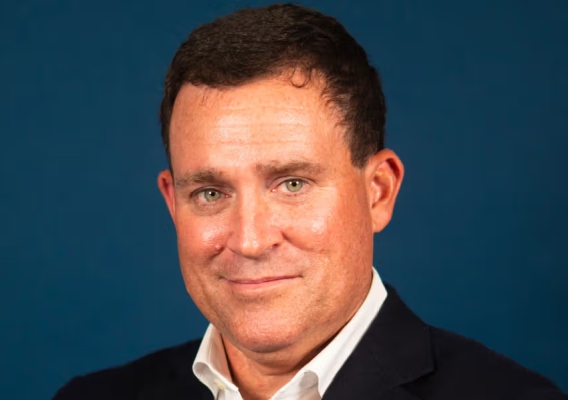
AT THE START OF 2026, U.S. Soccer hired Dan Helfrich as the federation’s Chief Operating Officer. His hire in the newly created position comes at a time when the United States is cohosting the 2026 World Cup and will be looking to make key strategic decisions to move the sport forward in the country in the years following the tournament.
Helfrich is graduate of Georgetown University where he served as the captain of the men’s soccer team and was recognized as an Academic All-American. Prior to joining U.S. Soccer, he served as the CEO for Deloitte Consulting LLP.
In his role at U.S. Soccer, he is tasked with overseeing the organization’s daily operations, “with a focus on optimizing business processes and executing key strategic initiatives to drive accelerated growth for the Federation.” He reports to U.S. Soccer CEO and General Secretary J.T. Batson.
Last week, Helfrich spoke with ASN about a number of key topics involving the future of the federation and how it intends to move forward following cohosting the 2026 World Cup.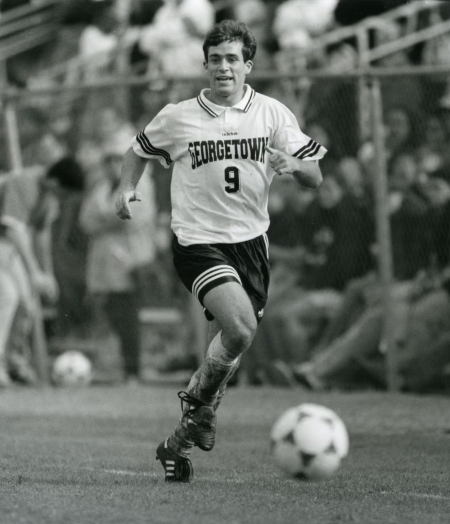
Brian Sciaretta for ASN: This World Cup marks an interesting moment for U.S. Soccer. In one regard, it's the culmination of years of effort to host this event. In another regard it's the start of a new era. The 1994 World Cup was like that too. While the USMNT played in the 1990 World Cup, 1994 is where it changed. The years that followed were more import than the tournament itself. A domestic league started that is still growing. The sport also became far more visible on television and in the media. Following this World Cup, what are the steps U.S. Soccer must take to achieve an impact similar to 1994? What are the lasting impacts U.S. Soccer wants this tournament to make?
Dan Helfrich: I view 1994 as creating the conditions for a foundation that didn't previously exist. And that includes a men's division 1 professional league with some scale to it. It includes a level of foundational visibility – media, etc. - and I think that foundation has served us very well in the 30 years since to where we are a soccer country in many ways - based on the amount of play, the quality of play the reach of play. The next period isn't about foundations; it is actually about transforming the system itself.
And transforming the system means everything from the standards of play all the way through a player's journey from very early ages. It includes rewiring a system to create way more access, way more affordability for players and families. It includes, at the very top of the sport on the men's side, being able to create the conditions for our already very talented 15, 16, 17-year-old players to accelerate their careers in the earlier stages of their professional careers - which is going to have benefits for domestic leagues and the national teams. To me, the simplest way to describe it is that '94 was the foundation including the top of the pyramid, 2026 transformed the whole system starting from the bottom.
ASN: When people talk about player development, there are many things that go into that. I have covered youth national teams for many years and the dynamic to that has changed. There was residency, Project 40, and all sorts of mechanisms over the years since 1994 to foster the development of top players. But the current environment is that these players are with professional clubs from a very early age. So much of their time is now with their club’s youth teams and academies. MLS teams continue to sign homegrown players at younger ages. USL teams are following a similar path which greatly expands the professional footprint of the sport to reach and identify players. But that begs the question of what can the federation do foundationally with player development if top young players are with their clubs 80-90% of the time?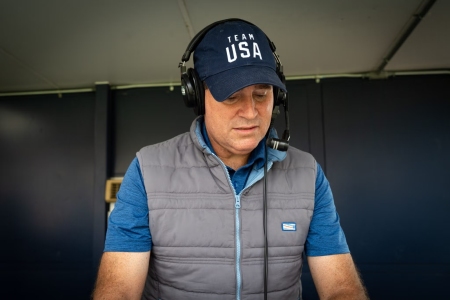
Helfrich: First of all, U.S. Soccer needs to view its role as orchestrating the entire system, not governing national teams only. So if you look at it that way, then you actually say the partnership between clubs and country, a partnership between U.S. Soccer and not only MLS academy systems on the boys side but national leagues and state associations like we have to care about and create support for and create standards for how all of those things operate together. You can change the game if you do that. So, now we can talk about player development for those players who reach core youth national team player status. There we talk about things like developing in shared individual development plans for players between the academy and US Soccer.
So, you're actually looking at data together with the club. You're building a plan for the players pathway together with a club. You might have a youth national team coach and the club coach on a call every month talking about the player together. That's the kind of partnership that we're beginning to unlock. So, there's not what I view as an artificial wall between the world of the club, the world of the player, and the word of the national team. It's one player. We all should care about that player's development and reaching their full potential.
ASN: U.S. Soccer's been undergoing a big change in recent years. Moving out of Chicago to Atlanta was huge for the organization. I know it is not something that can be done overnight, but in the months and years following this World Cup, are you expecting structurally the organization to change a lot in terms of maybe new positions and a different hierarchy? Is it something that you expect to look very different years from now?
Dan Helfrich (SFS’98, MBA’99) is the U.S. CEO of @Deloitte Consulting. But every fall, no matter his schedule, he carves out time to call @GUHoyasMSoccer games for his alma mater.
— Georgetown University (@Georgetown) December 6, 2024
Read the full story: https://t.co/pQh19EqNMl pic.twitter.com/rGRcnSKuAR
Helfrich: I view this as a logical moment to look at the goals we've established. We've established some really long-term goals, but in particular, we've looked at a set of goals what we're calling 2032 goals. If you have a set goals, then I think it's the right time to look at structure - the way people work together and to try to define what's best suited for the new set of goals in a sport that's evolving very quickly. I anticipate we will evolve the structure to hit those goals. And we have a chance in the months to come to do that. I think we'll take advantage of that throughout the entire organization, including in the core "sporting structure" where we have to recognize that, for example, the men's and women's games around the world and in the US are very different than one another on certain dimensions. And we need to make sure that our structure reflects the nuances of those pathways. We can talk about lots of those examples and we're going to be open to evolving because that's what the mission ahead of us requires.
ASN: On the field, the process has begun. The team is now together. There was the big announcement in New York. But in terms of captivating the public in the way that it did in 1994, I assume you must be pretty optimistic at this moment about what the tournament looks like in terms on the field success, not just the legacy that you hope to leave.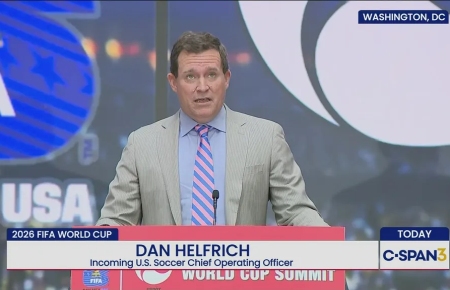
Helfrich: We hope, expect, and are planning for this summer to be a catalyst for a lot of the work that is to come. And so we're spending a lot of time focused on how do we help as many tens of millions people to experience the World Cup - and in as an accessible a way as possible. That means setting up community-fests in hundreds of communities. It means having a fun, free soccer house on Venice Beach. It means, in the lead up to the World Cup, games and trying to create environments in Charlotte and in Chicago that are awesome and include tens of thousands of tickets at under $50.
We're trying to create as much energy for as many people to experience the World Cup in a very personal way. And then finally, yes, we're optimistic about the way the team is feeling. It should be a fun few weeks that hopefully become many weeks.
ASN: One question I've had for awhile with the men's national team is keeping the team relevant between World Cups. The World Cup tends to see a huge swell of enthusiasm, but the years between are a different story. There have been some low attended games. But now we're looking at a typical cycle in those in-between years as being two Gold Cups, various Nations Leagues, and World Cup qualifying that is far more diluted than in the past with 48 teams qualifying. That is a lot of CONCACAF. U.S. Soccer has found some ways to break this pattern with creative and ambitious scheduling - such as hosting the 2016 Copa America Centenario and the 2024 Copa America. But those were exceptions and irregular events. I know these decisions are made on multi-levels, including you, J.T. Batson, and maybe the next sporting director, but keeping the team relevant between World Cups and in ways that challenge the team and grow interest in the team must be something that you and other key decision makers in the federation talk about frequently behind the scenes.
Helfrich: Of course. And you know our two jobs with the senior teams are to generate excitement, visibility, and access for our fans which you know you may frame as relevance. And also to create opportunities for growth and development to prepare them for major tournaments. That's the twin goal and we talk about them all the time. When we talk about match scheduling, we're talking all the time about how do those two goals, visibility and access and fan excitement and the goal of competitive preparation, how do those best combine? And, of course, there's constraints on that because of...
ASN: The region we're in and the competitions it entails…
Helfrich: And so you understand those constraints but you there's a lot of room even within those things that are fixed to achieve those two goals. That takes a lot our attention that's both on the men's side and the women's side.
ASN: You know everyone wants to see the U.S. play teams like Brazil and Argentina. Being involved with the Copa America spoils fans and then it is disappointing when you realize those type of events are not regularly scheduled. But it requires you at the federation to keep thinking outside the box, especially coming out of this World Cup with ambitious goals.
Helfrich: I am confident in the way we're managing with that set of conditions. But the other thing I would say is, and you know very well the importance of youth national teams. You likely understand the importance of the Olympics. And there's a lot of data that suggests that success in youth World Cups and in Olympic cycles on the men's side, create, accelerate player development and create the conditions for success in subsequent World Cups. Think about the one time the U.S. men have been in the medal round of the Olympics is 2000 in Sydney. That was followed by our best finish ever in the World Cup.
ASN: John O'Brien, Josh Woff, and Landon Donovan all used that tournament to go from youth national teams or small roles on the U.S. team and into important players very soon afterward.
Helfrich: Six players from the 2000 Olympics team featured on the 2002 World Cup team. I share that because you will see us strategically investing more attention and resources and focus on the youth national team games program, on elevating the men's Olympic team to prepare us to be in the best competitive position. I think those things will have a significant role in the competitive preparation for our future men's World Cup and other major tournament performances.
And I also believe if we do things well, we can also create more visibility for players at earlier stages in their career to create more stars - and that's good for the sport. One of the things that I'm excited about in having the new training center is I think we'll be able to attract top youth international teams to come play our teams. I think will be able to broadcast those games from the national training center in a way that we be promoted, make available in a far more accessible way than they have ever had before. And I think those things will pay off in our senior team performance over time.
We are excited to welcome Dan Helfrich as U.S. Soccer's new Chief Operating Officer.
— U.S. Soccer (@ussoccer) November 17, 2025
???? https://t.co/tBoba3t5qR pic.twitter.com/LpTqUuX6Wt
ASN: The Olympics has always captivated the American public and team sports benefit from it. Just look at the U.S. hockey team earlier this year. It sounds as if U.S. Soccer is really going to get out in front of the men's team which will get to play on home soil in a tournament that will be played all across the country.
Helfrich: No question. And what the professional technical analysis would tell us, which would match what we see with our own eyes, is that you our player pool right now in the age 17-21 group on the men's side is a very talented player pool. Again, we need to work with all the professional teams that they are part of to grow and develop those players. But it's a high potential player pool and we're going to lean into that in the years to come
ASN: I know Matt Crocker left abruptly and I know a lot of the work he did for this World Cup was already done and that his departure probably wasn't going to affect anything with the World Cup. But what's the timeline, U.S. Soccer is thinking to have a new sporting director in place? Mauricio Pochettino's deal will end at the World Cup. In two months, U.S. Soccer will not have a sporting director, a coach for the men's national team, or a coach for the men’s Olympic team - which you said is a priority. How quickly do you need clarity on all of that to make sure the teams continue to move forward? Are you prepared to begin the next cycle or to go for a long time with interim coaches or sporting directors? The question, I guess, is more about the timing to resolve these vacancies.
Helfrich: The first thing we're thinking is we should be laser focused on this summer's team and let Mauricio, Jesus and their staff deliver what they have very well put in place over the last couple of years. And then, like any thoughtful organization, we're prepared for a variety of scenarios with a variety of timing in the months to come. But that's been part of a disciplined process. And we feel very equipped as we sit here today to make the choices that we need to make in the time that's in front of us with a lot of confidence and a lot optimism.