

USMNT analysis
With Pochettino returning for the 2030 cycle, a look at the challenges & opportunities ahead

ON MONDAY, U.S. SOCCER made a major announcement that Mauricio Pochettino has agreed to a new contract through the 2030 World Cup. The move will now ensure continuity for the program through another cycle.
It has been well known that U.S. national team coaches who have attempted second cycles have not been successful, without exception. After a run to the quarterfinals in 2002, U.S. Soccer rehired Bruce Arena for 2006 and the team did not advance out of group play.
Bob Bradley was fired a year into his second cycle in 2011 after the U.S. team lost to Mexico in the final of the Gold Cup. Jurgen Klinsmann was fired at the end of 2016 after a poor start to the hexagonal round of World Cup qualifying. Gregg Berhalter was then dismissed in 2024 after his team failed to advance out of the group stage at the Copa America.
U.S. Soccer is hoping that the biggest difference in this case is that Pochettino has only been on the job for 18 months, and his first cycle was not a full cycle.
For Pochettino, this will allow he to continue to leave a lasting imprint on the U.S. team and for U.S. Soccer, this will allow the organization to keep on the same track without having to undergo an exhaustive coaching search.
Discussions between U.S. Soccer and Pochettino began before the World Cup, paused during the tournament, and resumed afterward.
Here are some thought on Pochettino’s new contract for a second World Cup cycle.
Talent Identification
This is going to be one of the trickiest cycles to manage for a USMNT head coach. Most of the team’s core players over the past 10 years will now be moving past their prime ages. This includes Christian Pulisic, Tyler Adams, Weston McKennie, Antonee Robinson, Tim Weah, Chris Richards, and Sergino Dest.
While Pochettino introduced several new players into the mix, he still relied heavily on the existing group of players. He will not be able to do so this time as it remains to be seen if these players will continue at a high level.
Over the last year, Pochettino was very successful finding players to introduce into the U.S. national team. Alex Freeman, Sebastian Berhalter, Max Arfsten, and Auston Trusty were just a few of the players who Pochettino successfully integrated into the team.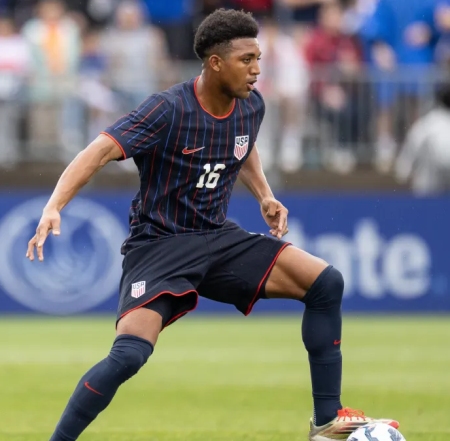
The fact that talent identification has been his biggest strength likely played a role in the decision from U.S. Soccer that he was the best candidate to take the team forward into the next cycle where there will be a lot more very important positions on the team up for grabs.
Talent identification is critical for the team to find players who can eventually allow a gradual and seamless transition between generations.
Pochettino will now be tasked with finding more players like Freeman and Berhalter.
Copa America
It is not formally announced, but the reports are widespread that the U.S. team will likely be involved in the 2028 Copa America again as the hosts. This will be an important midcycle evaluation for Pochettino based on the direction of the team ahead of its first World Cup qualifiers in over six years.
At the Copa America, we will likely see how Pochettino is preparing his team for 2030, what type of players he wants to bring into the mix, who he sees as fading out, and whether the team is buying into this plan.
As a native of Argentina, Pochettino likely grew up viewing the Copa America as a significant and very important tournament. As a player, he participated in the 1999 edition with Argentina (which were bounced in the quarterfinals by Brazil).
The opportunity for him to coach in the tournament was likely a very attractive part of the decision to return to the U.S. team.
Olympic team
Just after the U.S. team ended its 2026 World Cup campaign, U.S. Soccer announced Steve Cherundolo as the Olympic team head coach.
Pochettino will need to develop a tight working relationship with Cherundolo to help build the Olympic team into a group that can quickly feed the full national team.
Spain, France, and Morocco were very successful at the 2024 World Cup and all three teams sent 5-7 players into their 2026 World Cup teams including many starters and important contributors.
Many of the young players who might be important to the U.S. team later in the cycle might not be ready yet. As top national teams like France and Spain have showed, the Olympic team can help bridge that gap and have players ready for the full national team immediately after the Olympics.
U.S. Soccer COO Dan Helfrich has said in interviews (including with ASN) that the federation is going to put a heavy emphasis on the Olympic team noting that there is a correlation between that tournament being useful in preparing players.
When Spain won the gold medal at the 2024 Olympics, head coach Santi Denia worked closely with head coach Luis de la Fuente (who coached Spain’s Olympic team to the silver medal at the previous games in Tokyo).
For the 2028 Olympics to be as beneficial to the program as it can be, Pochettino and Cherundolo will need to work together closely. If that happens, the benefits could be significant to the U.S. team in 2028.
