
USMNT analysis
Analysis: USMNT completes perfect window with 1-0 win over Canada

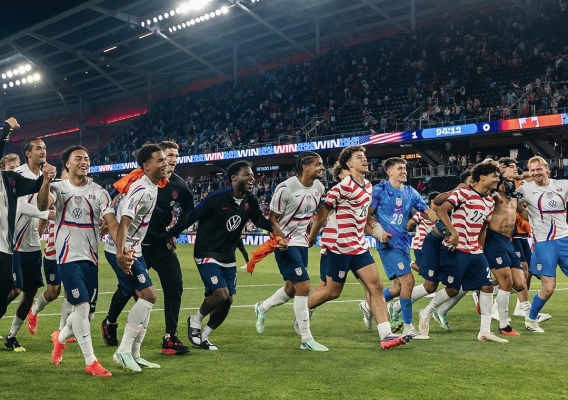
THE UNITED STATES NATIONAL team capped off a perfect four-game international window with a 1-0 victory over Canada in Minnesota on Tuesday night to begin its new cycle with wins over Peru, Chile, Mexico, and now its northern neighbors. The win over Canada was not pretty as the game lacked rhythm and was often sloppy. But the defining story was that the winning goal from Justin Ellis mean that teenagers in their first U.S. national team camp accounted for seven of the team’s 12 goals over these four games.
Ahead of the game, head coach Mauricio Pochettino admitted the team wasn’t in a great condition due to a congested four-game window. He went with an experimental lineup that tested players in different roles. Auston Trusty started at left back, Yunus Musah and Brooklyn Raines were together in central midfield with little chemistry together. Mathis Albert made his first USMNT start while Ellis made his second start. Brian Schwake made his first start in goal.
Playing against Canada, the U.S. team was facing a more rested opponent that only played two games this window and against a team that was very physical.
The game began with neither team playing well but Ellis broke the scoreless deadlock just minutes after he was hobbled with an ankle injury (where he it appeared he might not continue). But on the play, Alex Freeman moved into the box effectively and sent a low ball across the box which Ellis was then able to tap in from close range. Canada protested for offside but there was no VAR in this game.
In the second half, Canada was on the front foot most of the time but the U.S. team’s defense would bend but not break to keep the clean sheet.
Here are some thoughts on the game and the window at large.
Teenage production was stellar
In this window, Julian Hall scored three times, Justin Ellis scored twice, and Mathis Albert and Cavan Sullivan each scored once. In total, seven of the U.S. team’s 12 goals this window were scored by teenagers.
That is extremely rare for any national team to pull off in such a short period of time. There was a lot of attention on the kids when the roster was named – and the kids delivered. In addition to the goals, Diego Kochen earned a clean sheet and Brooklyn Raines was a useful addition to the midfield.
Julian Hall replaced Ellis in the second half and once again impressed with his movement, although he missed Malik Tillman who would have had a wide-open net to shoot. Cole Campbell made his debut in the 61st minute as an injury prevented him from playing in the first three games. He showcased his speed in a few moments but overall did not make much of an impact. Neil Pierre and Adri Mehmeti came into the game late.
Alex Freeman to Justin Ellis… Orlando City producing for the #USMNT https://t.co/bNOft5n9gE
— Brian Sciaretta (@BrianSciaretta) October 7, 2026
As expected, not all of the 13 Olympic eligible players stood out, but none of them looked lost in the moment. It was a very useful camp that will be long be remembered for the first international steps of a promising new generation of players.
MLS will certainly be enthusiastically putting out stories about the production of the kids because many of them are either in MLS or began their careers in the league. Ultimately, that is a good thing for the league to publicize. Moreso than acquiring ageing stars, being able to launch the careers of USMNT players is just as impressive – especially at the rate the league’s teams have done the past year. Even before this group, it was Freeman, Berhalter, and Trusty who all scored at the World Cup.
Many of these kids will eventually be sold, as Zavier Gozo was done this summer, but these players were all ready for the USMNT while still based domestically.
What’s next for the kids?
For those of the 13 Olympic eligible players based abroad, only Diego Kochen and Cole Campbell earn regular minutes at the first team level of their clubs. Players such as Mathis Albert and Zavier Gozo need to find a way to get onto the field this season, even if it requires a loan.
For the MLS-based players, the MLS playoffs push is ahead and now is a chance to continue their momentum and continue to lead their teams.
But for everyone, there are the two remaining international windows left this European season (November and March). For MLS, there is also the traditional winter camp that was previously known as “January camp” but will now be in December.
One of the main themes from this USMNT camp is that it was the last window before the U.S. Olympic team will get underway. U.S. Soccer has said it is prioritizing the Olympic team. For a few, there might also be the U-20 national team.
Cavan Sullivan and Diego Kochen are the Olympic eligible players from this squad who have the best chance of earning a call-up to the full national team next month. There is not a lot of room when you look at the number of full national team players who are likely to soon return.
How the USMNT and the Olympic team are divided in the coming two years will be very interesting. It might be that that some younger players move from team to team each window. But when the Olympics draw closer, there will be a lot of pressure to field a team that can medal on home soil. The Olympics has a way of galvanizing the American public in ways other tournaments simply cannot. On top of that, it gives young players a chance a to lead a team and be more prepared for important minutes on the full national team than they otherwise would have been playing sub minutes for the U.S. team.
Freeman’s big camp
For the U.S. team, the veteran players helped pave the way for the young players to succeed. Against Mexico, the defense played well and only required Kochen to make one save. Hall and Ellis were able to score multiple goals with the help of great service from players such as Sebastian Berhatler, Gio Reyna, and Alex Freeman.
In terms of which veterans played the best, Berhalter was the best U.S. player the first two games against Peru and Chile. Freeman was the best U.S. player against Mexico and Canada to conclude the window.
Nothing for free from Alex. ???????? https://t.co/oybwhmzo2H
— U.S. Soccer Men's National Team (@USMNT) October 7, 2026
Freeman was the difference maker against the U.S. team’s two best two opponents from CONCACAF. Against Canada, he set up Ellis for the goal and made several impressive defensive stops to cement himself as the most complete right back in the U.S. team’s player pool.
Canada had most of the ball in the second half but Freeman did the most work, particularly in guarding Jacob Schaffelburg for 72 minutes, to keep Canada off the scoreboard. Freeman was important to Pochettino at the World Cup and he will be instrumental to the team in the coming four year cycle.
Raines shows usefulness
Brooklyn Raines started and played 61 minutes against Canada. He appeared in all four games this window with two starts (including going the full 90 against Chile).
Overall, it was a very good window for Raines he showed himself to be a smart and useful player. He’s not very adventurous in his passing, and perhaps he plays it too safe, but his positioning and reading of the game is at a high level. He knows where to be at all times offensively and defensively. Against Canada, he won six out of seven ground duels and drew four fouls.
Raines is likely going to have a big part in the Olympic team but after that, it is easy to see Pochettino finding a way for him to be useful.
Schwake passes test
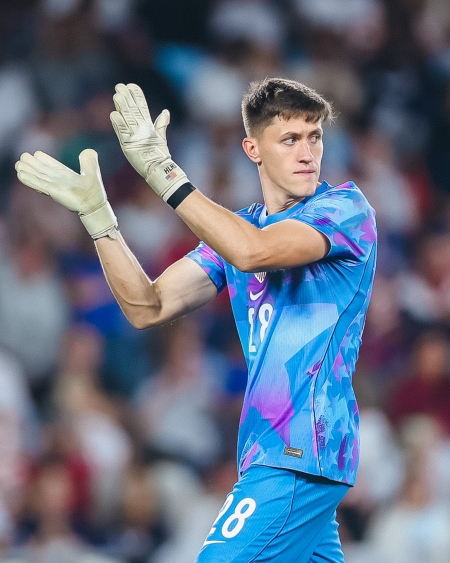
Like Diego Kochen, Brian Schwake also had a decent camp. Both posted clean sheet wins and neither were forced into making a lot of saves. Schwake deserved the opportunity to be here amid a very strong season for MLS-best Nashville SC. After the performance against Canada, he’s likely to earn at least another call-up moving forward.
Schwake had three saves and was decent with the ball at his feet (only making one mistake that went for a corner). But the good news for him is that the national team staff will be watching him closely moving forward.
Glove save and a BEAUTY from Brian Schwake to preserve the victory in Minnesota! ???? ???? @ATT Play of the Match https://t.co/MGJZFvRfgY
— U.S. Soccer Men's National Team (@USMNT) October 7, 2026
Schwake gives Pochettino more options in goal should Kochen play with the Olympic team.
Reyna starts four games
Gio Reyna had a strong camp with the U.S. team and it was a very good sign for him that he was the only player to start all four games. Pochettino wanted to test Reyna’s durability, which has been a constant question mark for him for several years.
Reyna responded by giving Pochettino four good outings. He was not a game-changer or ever the best player on the field, but he was typically solid and had at least a few nice plays every game.
But in a year when there was so much doubt about whether Reyna was in a bad place for both the club and country, Pochettino is making strong signs that Reyna is very much in his plans.
Rating other veteran performances
When looking at the other veteran performances, there was a range of quality.
Yunus Musah earned the start against Canada and did not have a good game. Outside of a few nice moments, he did not help the U.S. team much.
Auston Trusty very much looked like a central defender who was playing out of position at left back.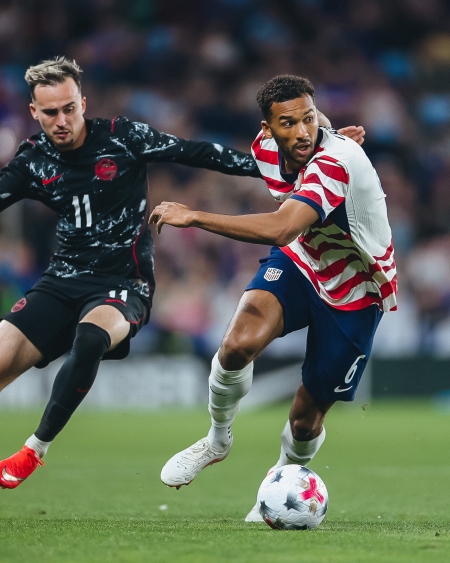
Chris Richards and George Campbell made for a physical central defense tandem both were effective passing out of the back but Campbell nearly committed an own-goal with a poor clearance.
Malik Tillman was important in the build-up to the first goal as he sent Alex Freeman into the attack. Overall, it was a rocky game from Tillman but he certainly had his moments of quality.
Sebastian Berhalter wrapped up a very good camp with a strong outing off the bench where his passing helped the U.S. team at a time when Canada was pressing.
Sergino Dest, Tyler Adams, and Antonee Robinson did not do much of note when coming into the game in the second half.
Haiti next
In November, the U.S. team will face Haiti for two games as part of the Nations League. If the U.S. prevails, it will return to the semifinal round of the tournament in March. Haiti advanced to this stage by finishing second in its group with Curacao, Dominican Republic, Costa Rica, Trinidad & Tobago, and Nicaragua. Due to political unrest, Haiti has not played a game in Haiti since 2021, and its home games have been in various places throughout the Caribbean.
Despite that, Haiti has been a tough team to play. Even at the World Cup, Haiti played hard and competitively in three losses to Scotland, Brazil, and Morocco. The U.S. team is going to have to play hard and smart to come away with a convincing victory.
